|
|
| Day 3: December 24, 2005 - Buenos Aires, Argentina |
|
|
| |
The focus of the day was
to see as much of Buenos Aires as possible. On our
own in the morning, we made our way to Recoleta
where we walked through the famous cemetery and
perused the wares at the arts and crafts fair. Recoleta
is a fancier, haughtier part of town. On our way
back, we passed the Brazilian and French embassies.
After lunch, we met our with our tour guide, Sol.
She was running late because she had a large group
of Germans in the morning. We returned to Recoleta
to learn more about the area and some of the famous
people buried there. Recoleta was founded by a group
of monks who were looking for a quiet place for
their monastery. At the time, Recoleta was sparsely
inhabited and close to the river. The monks built
there and were eventually chased out by the government
when everything was nationalized. Since then, the
church has returned to secular hands and thrives
in this rich area.
The church was built with original colonial fixtures
including alabaster windows. The church has some
restorations around 1930 and you can clearly tell
the restored from the colonial. There was even a
chapel up front with religious relics from Europe.
|
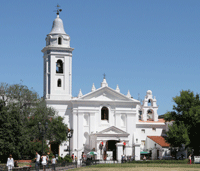
Recoleta church |
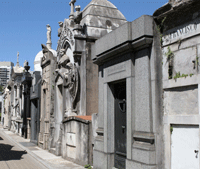
Mausoleums in Recoleta cemetary |
| |
The attached cemetery is fascinating. Everyone is
buried in a mausoleum and you can see a lot of coffins
through the doors. There were also some crypts spread
throughout, which seemed out of place. But then
you realized that each mausoleum is from different
years and can exhibit vastly different styles. It
ranges from the very simple walk-ins to extremely
ornate with chapel and stained glass windows. Each
mausoleum costs a different amount to keep up or
resell based on it's size and location. What amazed
us was the revelation that each mausoleum could
have 2-3 floors below ground (approximately 21 feet).
There were also differences in the access methods
- some had doors to walk through while others seemed
like drawers. Each mausoleum is in a different state
of repair based on who is paying (or not) their
fees.
The inhabitants range from generals and presidents
to revered priests and other heroes of state. Mixed
in is a who's who of the rich and powerful and then
the occasional unknown. Among the generals and state
heroes were the Alvear family. The grandfather fought
on the continent with San Martin, the father was
a mayor of Buenos Aires and the son went on to become
the president of Argentina. Evita was also there.
Two stories are really worthy of note. The first
is the story of General Aramburu who overthrew Peron.
The Peronistas kidnapped him and later killed him.
His body was interred in a crypt and in 1974 the
Peronistas stole his body and held it for ransom.
The ransom was the return of Evita's body to the
Duarte family crypt. The ruse worked and her body
was returned from where it was hidden in Italy.
The second story was about a young girl presumed
to be around 15 years old who fell into a narcoleptic
state and was mistaken for dead. Her parents had
her interred and later a caretaker heard noise coming
from the mausoleum. By the time the family arrived
and opened the coffin, the girl had truly expired.
From Recoleta, we drove to the Centro district and
spent time exploring the Plaza de Mayo. On the way,
we passed the obelisk and found out that it was
erected on the 400th anniversary of the first founding
of Buenos Aires. That capital eventually moved and
became Asuncion, the capital of Paraguay.
The Plaza de Mayo contains the colonial town hall,
the Catedral Metropolitana and the government house.
We got there at the changing of the guards and rushed
into the cathedral in time to see the guards take
up station at San Martin's crypt inside the cathedral.
To his left were the remains of General Alvear.
The cathedral is massive and ornate.
|
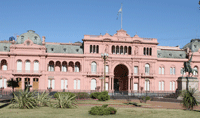
Government House, Casa Rosada |
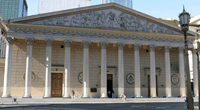
Cathedral Metropolitana |
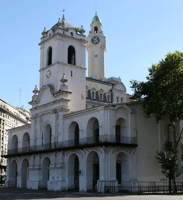
Colonial Town Hall |
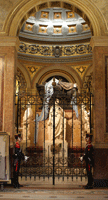
Guarding San Martin |
| |
We walked back out to the plaza and learned that
the mothers of the disappeared march around the
pyramid every Thursday until their sons come home.
Across from the pyramid is the government house.
It is painted pink in a gesture of cooperation of
the two national parties - one whose colors are
red (federalistas) and the other is white.
From Centro, we drove into San Telmo which is an
older part of town. It used to be where the rich
lived until an outbreak of yellow fever drove everyone
out of the area. We stopped to look at two common
architectures there. The first is referred to as
Chorizo or sausage because everyone lived in a line
and overlooked a common garden area. The second
architecture type was centered on a common plaza
with each family having a very small room off of
a common area. They would share kitchen and restroom
facilities.
|
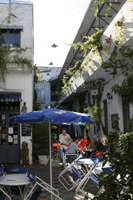
Sausage house in San Telmo |
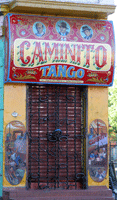
Tango parlor in La Boca |
| |
From San Telmo, we drove to La Boca - one
of the poorest areas in the city. It is known
for two things: tango parlors/brothels and
the home of the Boca Juniors Soccer team.
Men used to tango with other men while waiting
at the brothels.
Boca Juniors is a very old club who had to play
another team for the rights to wear the colors black
and white. Boca lost and one of the team members
vowed that they would take the colors of the first
ship to enter the harbor the next morning. They
ship was Swedish and Boca Junior's colors have been
blue and gold ever since. Their home stadium is
old and is referred to as a box because the seating
is so steep.
La Boca is also home to an original community of
dock workers and ship members. The houses are very
colorful because the tradition is to paint your
boat a very bright color and then use any remaining
paint on your house. Their spirit may be high, but
the harbor, the original Buenos Aires harbor, is
so polluted that you can't stand near it for very
long.
We returned from La Boca past the second port of
Buenos Aires - Puerto Madero. This port is still
active, but is not the main port anymore. Passing
Plaza San Martin, we made it back to the hotel to
rest before our Christmas dinner at a steakhouse.
Christmas dinner was a complete disaster. We had
fun, but all agreed that Argentina is not known
for it's cuisine!
|
|
| |
|
|
|
|